الجمعة، 18 فبراير 2011

Do Images in Posts Encourage Reading?


Do Images in Posts Encourage Reading ?


I begin almost every post here at Pro Blog Design with an image. The images are usually interesting, and do take a while to pick out. Do they encourage people to read more posts?
The answer is that for a certain type of blog, they do. For another type, they don’t.

When Post Images Are Worth Adding

  • In plain templates. Many blogs are designed to be minimalist and plain, allowing the content to be focused upon. A well selected image in the post can work wonders for adding personality to the design, without losing the clean simplicity.
  • In product related blogs. If you are discussing a certain item, be it a book, gadget or anything else, your readers will expect to see the item as well as hear about it. In such cases, it may even be worth having your post image link to a full size version of the product.
  • In design related blogs, such as this one. When your readers are hear to read about design and visual interest, it only makes sense to add extra visual interest to your posts themselves. With an audience that appreciates a good design, a good photo will not go amiss.
  • In series of posts. Darren at Problogger exemplifies this strategy, with each of his receiving their own basic logo, which he uses at the start of every post in the series. Some normal posts also receive images, but not all.

الأحد، 6 فبراير 2011

How to test a fuel pump relay switch


I help people fix their cars over the internet as a main source of income to pay my bills and support my family, and have never heard of such a thing. Many people get the two of them confused, or say one thing when they really mean another. So I am going to try to straighten some things out for you in this article, and then if you need more specific help, I can do that also. Read on...
Okay, for one thing.. Whoever wrote the title for this article 'How to replace a fuel pump relay switch' is a complete moron who has no clue what a relay is or does. Another thing.. There is a relay, and there is a switch.. I am going to assume that they are talking about the relay, and to replace it is very simple, just pull it out and put in a new one. So you know if someone says they had to change the relay switch, then they have no idea what they are talking about.
Where the switch part comes into play is the computer shoots power to the fuel pump relay when the ignition switch is turned to the run position. So in a sense, the computer is a switch also. If you want some more explanation about how this system works on your particular vehicle.. click here (link opens in a new window)and ask me a question about it. I say this because not all vehicles do this the same way. Some go through theft systems, and another series of relays befre they get to the computer.. and then once the signal leaves the computer and grounds the relay, there is sometimes even another switch between the relay and the pump itself.
This can be a complicated system and it is not always as easy as changing a relay to make it work again. The relay is usually located in a under the hood fuse box (or relay center), they are not always labeled as to which relay is for which system either. This is another good reason to click here (link opens in a new window) and talk to someone who knows all the specific details about your vehicle.
Now we will talk about the 'switch' part of the system. If you want to change a 'mechanical switch' then that switch would normally be the one that the ignition key actuates when you turn it. Sometimes this switch is part of the actual cylinder that the key fits on, and sometimes it is further down the steering column, and is actuated by a rod. Again, you would have to talk to an expert on your particular vehicle to be more familiar with the specifics.
Ok, hopefully by now you know the difference between a relay and a switch.
Have a good one, and thanks for reading.

الخميس، 3 فبراير 2011

AUDJPY: Profit Is My Density

No, that's not a typo. It's a rip-off of a line from the Back To The Future movie. Anyway, this post is another in the series of theoretical considerations with respect to various robot building strategies.

In this scenario let's consider fixing our maximum total position size across a specific price range. For example, perhaps we are willing to purchase 10000 units per 1000 pips (remember, I'm generally talking about small account sizes). For Oanda traders this will run you up to about $175.00 in margin.

If you want to limit your overall positions to 10% of your account capital then you'll have to ante up $1750.00 to play in that 1000 pip range. Obviously, a large account value will either give you a larger playing field or a higher density of positions if you don't expand the playing field.

Are you still with me?

I know, at this point things are pretty boring. In fact, we're looking at a simple grid that we can play every time price passes through our space. However, this gets a bit spicier if we can find a way to optimize the open and close activities. 

For example, what if we can compress our position openings towards the low end of a short term movement? Similarly, what if we can compress our position closings towards the higher end of price movements within our price space?

If you have good ideas for these processes, then you are set!

My thought is to adjust the probability of closing profitable positions based on the amount of profit a position embodies. For example, perhaps a position with a 10 pip profit has a 1% chance of being closed while a 20 pip profit has a 5% chance of being closed -- per bar. What would this do to the expected profit per position? Are some probability formulas able to provide much better returns?

Remember, we're talking about trading a maximum density of positions while prices move through our trading space. We know our total position, our total risk, and simply want to allow our winners to run as much as we can based on historical price movement patterns. Basically, we know that prices range for a while and then take off up or down. It's the multi-day upward movement that we want to catch... letting go of positions slowly during smaller moves until we can eventually latch onto a bigger move.

I'm probably about 85% into building a new robot based on this concept. I like the measured aspect of this on the risk side. I like the less definable profitability expectation -- it's beyond my math skills at any rate -- which is suggestive of an ability to preferentially capture larger profits. I also like that it should continue to eek out smaller profits if the price decides to languish in a smaller range for some period of time.

Maybe I'll be able to fire this up on Monday.

Return Of The Robots

Once again I am purely a robot trader.

Part of the reason is that my day job does not allow me to use company Internet or computing resources for the purpose of earning revenue. This is a sensible restriction even if my use would only have been to let me view charts and enter trades.

Now I use the Internet at work purely to watch how my robot is doing. I don't enter trades, I can't access or change the robot's behavior during the day, so really, I'm watching buy and sell events for entertainment purposes. As long as it isn't chewing up bandwidth or interfering with my productivity that is alright.

The latest incarnation of live robot is a bi-directional trader. The theory is that at any point in time prices are going to move in some direction for a while and then in the other direction. This back and forth movement will continue endlessly.

Conceptually, break the bi-direction robot into two unidirectional robots.

With that done, admittedly, it is possible that one of my robots will run out of ability to trade as the price moves a long way in the wrong direction. However, my other robot will be earning a profit during this time. Additionally, I am certainly able to manually reallocate resources between these two robots if and when conditions support the reversal of a large movement.

With the volatility of last week this reasonably cautious robot did fairly well. However, this robot isn't suitable for professional trading as it is allowed to hang onto negative positions for a long period of time.

Perhaps the most important aspect of this robot is the sound it makes whenever it closes a profitable position. Hearing the ka-ching sound whenever there is price movement up or down is very rewarding... as it happens so often.

الاثنين، 31 يناير 2011

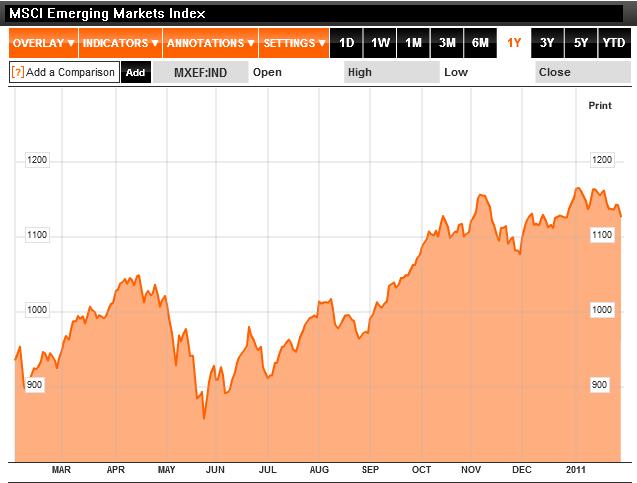
Emerging Market Dilemma: Currency Appreciation or Inflation?

By now, we’re all too familiar with both the so-called currency wars and its underlying cause – the inexorable appreciation of emerging market currencies. As more and more Central Banks enter the war in the form of forex intervention and capital controls, however, they are inadvertently stoking the fires of price inflation. They will all soon face a serious choice: either raise interest rates and cease trying to weaken their currencies or risk hyperinflation and concomitant economic instability.
This dilemma is fairly basic: a Central Bank cannot simultaneously control its currency and conduct an independent monetary policy. For example, if it seeks to adjust interest rates to serve domestic economic goals, it must understand that this will have unavoidable implications for demand for its currency, and vice versa. These days, that dilemma is becoming increasingly sharp. Inflation in many emerging markets is rising to dangerous levels, real interest rates or negative, and all the while, latent pressure continues to bubble under their currencies.
The problem is that investors have become so desperate for yield that they are willing to tolerate negative real interest rates in the short-term if they believe that interest rates and/or currencies will inevitably rise over the long-term. While capital controls have forced a modest decline in the carry trade, the expectation is that an inevitable tightening of monetary policy will soon make it viable once again.
Due to the ongoing (perception of) currency wars, emerging market Central Banks are trying to hold out for as long as possible, lest they make themselves into sudden targets for carry traders and currency speculators. Some have already bitten the bullet. Brazil, for example, raised its benchmark Selic rate to 11.25% recently and indicated additional rate hikes will follow. China has embarked on a similar path, but from a lower base. The majority of countries remain in firm denial, however. Last week, Turkey took the unbelievable step of lowering interest rates in a vain attempt to decrease pressure on the Lira.
Most Central Banks believe that they can enjoy the best of both worlds by cutting access to credit and raising banks’ reserve requirements (in order to combat inflation) and maintaining strict capital controls (in order to limit inflation). While they should be patted on the back for creativity, such Central Banks must understand that their efforts are probably doomed to fail over the long-term. That’s because currency investors understand that only a masochistic, short-sighted Central Bank would pursue a weak currency policy in spite of rising inflation for a sustained period of time. Unless economic growth slows (which is unlikely without certain policy measures) and/or inflation magically abates (due to steadying food/commodity prices, etc.), they will eventually have no choice to concede defeat. “Central banks view the level of exchange rates as the priority rather than using them to help slow inflation. Once you start targeting multiple objectives, the odds for policy mistakes increase,” summarized one strategist.
The only win/win solution involves a simultaneous appreciation of all emerging market currencies. This would alleviate some inflationary pressures without altering the competitive dynamics of national export sectors and negatively impacting economic growth. According to the Financial Times, “There could be a surprise agreement to rebalance currencies at the Group of 20 this spring, although the failure of its November summit does not augur well.” Besides, any agreement would probably be in the form of a reiteration of the status quo, in which emerging markets independently (rather than in concert) pursue similar economic policy objectives.
For better or worse, emerging market governments have started to refocus the blame for the currency wars away from the US and towards China. Regardless of whether the US is at fault for its quantitative easing program, emerging markets compete with China – and its allegedly undervalued currency – in matters of trade. Pressuring China to allow the Yuan to appreciate, then, would ultimately go a lot further in ending the currency war and eliminating their predicament than screaming at the Fed for flooding the world with Dollars. Due to a new President and shifting politics, Brazil is angling to force the issue.  Given that China is currently in the same boat (rising inflation with low interest rates), this might be the straw that breaks the camel’s back. “China may be more sensitive to what the other major emerging market countries think about its currency. It undermines their moral high ground when it’s Brazil criticizing them instead of the U.S,” observed one analyst.
In any event, barring some unforeseen crisis and a flare-up in risk aversion, emerging markets are expected to continue attracting outside capital (more than $1 Trillion in 2011 alone), and their currencies are expected to continue their steady, upward march.

National Email Unsubscribe Day January 3, 2011

This morning I was sifting emails and realized that I've been receiving a large number of emails that I probably should have unsubscribed from by now. You know which emails I'm talking about - the ones that don't annoy you enough to unsubscribe from but at the same time provide absolutely no value.

I also noticed that a number of the emails are actually somewhat difficult to unsubscribe from. Not only is this boarding on violating CAN SPAM legislation from years ago, but is simply a nuisance. My first thought as a Marketer was to create a master list of companies that one can receive email from and then rate how frequently emails are sent (daily, weekly, etc.) and how valuable they truly are. Now that would be a long list!

For example, companies like Vista Print send TONS of emails once you buy something from them. Is this really necessary? I guess they're making money from it all but the good news is that it's relatively easy to unsubscribe. Have you had an annoying experience with email? I bet you have. We've all experienced messaging that was either excessive or just not useful.

National Email Unsubscribe Day January 3, 2011
 
Instead of building a list I thought it might be even better for Marketers and Consumers to do a little house cleaning, I mean email purging. Personally, if someone is receiving my emails and just deleting them, I'd rather they not be on my list form a marketing perspective. Having a clean email list is great for us because it allows us to better understand our true reach and effectiveness with marketing campaigns.

From the consumer side, why fill up server after server with useless junk. Think about how much more productive we'd be if we didn't have to wade through hundreds of unwanted emails each week.

Instead of just talking about it, I really want to do something about it... but I need your help.

I'm declaring January 3rd and National Email Cleanup Day. That's right.. in the beginning of the new year, I'm picking a day for all the world to unsubscribe from unwanted emails, delete emails that have been lying in your Inbox or saved folders for more and a few months, and make a statement about careless marketing tactics. Essentially I'm asking you to help me cleaning up our virtual world. Fewer emails means less computing power needed, less waste, less pollution, and more free time. Will you help me spread the word?

Can we spread this message throughout the world? I think we can. Send a link to this post to 3 of your friends or simply send them a message about January 3rd. Facebook it, Tweet it, share it on your favorite social media site. Let's see how we can change the world with just a few emails :), posts, and shares!

David Bain's 26 Week Internet Marketing Course

The best way to get really good in Internet marketing is by learning from an Internet Marketing Expert.  I can say that with confidence because personal experience has taught me that trying to successfully navigate the Internet marketing landscape is not easy task.  With more than a decade of experience it's clear to me that having a mentor and learning from others who have already taken the journey is the fastest, most effective way to learn about marketing and making money online.


Click Here to Learn About The Free 26-Week Internet Marketing Plan
 Framework

Being involved with SEO and Internet marketing, I've been blessed with meeting many qualified Internet marketing experts who are looking to help others succeed online.  David Bain is no exception.  David has been teaching Internet marketing for years and has reached thousands of students.  After personally reviewing his program I can tell you that it is one of the best, most comprehensive (although easy to understand) programs I've ever seen! 


The 26-Week Internet Marketing Program is the most comprehensive program for learning about online marketing tactics, showing you precisely what it takes to run a successful internet marketing campaign.  This online training program is ideal for website owners, bloggers, marketing managers, business owners and entrepreneurs.

David Bain, the founder and producer of the 26-Week Internet Marketing Plan is giving away this online marketing framework as a mindmap - very cool. Click here to check it out.

I've taken a very close look at David's materials and can share with you all of the different areas he covers in this one-of-a-kind program.  What I personally like is that content is given in reasonable chunks over an extended period of time.  In just a few minutes each day you can accumulate the knowledge that many so called "Internet marketers" still do not possess.

Here’s an overview of what’s included in the 26 Week Internet Marketing Course:

MODULE #1: WEBSITE STRUCTURE
  • Week 1: Market Research & Business Strategy
  • Week 2: Keyword Research
  • Week 3: Site Structure
  • Week 4: Data Capture & Marketing Funnel
  • Week 5: Conversion Rates
  • Week 6: Visitor Tracking

MODULE #2: GET SOCIAL; TURN ON THE TAP!
  • Week 7: Blogging
  • Week 8: RSS
  • Week 9: Twitter, LinkedIn,  Facebook
  • Week 10: Social Media Syndication
  • Week 11: Reputation Management
  • Week 12: Press Releases
  • Week 13: Pay Per Click

MODULE #3: LINK BUILDING
  • Week 14: Major Directories
  • Week 15: Niche Directories and Review Sites
  • Week 16: Location Specific Marketing
  • Week 17: Competitor Backlinks
  • Week 18: Beg, Barter or Buy
  • Week 19: Blog & Forum Comments
  • Week 20: Guest Posts

MODULE #4: CONTENT MARKETING
  • Week 21: E-Books and Viral PDFs
  • Week 22: Content Hubs and Feeder Sites
  • Week 23: Article Marketing
  • Week 24: Audio and Video
  • Week 25: Blog and Web 2.0 Site Distribution
  • Week 26: Bookmarking and Social Sharing
The actual mindmap goes into a lot more detail, breaking each week down into the individual tasks you'll be working on to learn the in's and out's of Internet marketing. Click here to view the full 26-Week Internet Marketing Plan Framework.

Start the new year off right with a commitment to learning. I know how good and effective David's material are - especially this program which was recently updated to include the latest and greatest online marketing tactics.  I encourage you to check it out if you want to succeed online in 2011.

P.S. If you purchase David's program using one of the links above, be sure to send me a note/comment on this blog.  I'd be happy to send you a FREE copy of my SEO training videos ($297 value) at no cost.  Happy Holidays!!!